What Information Is Most Important When Determining What Fastener to Use?
Purchase Anchors
Brick anchor fasteners attach an item to bricks or mortar joints in a brick wall. Brick anchors are used in place of concrete fasteners considering brick contains hollow spaces, different concrete that is solid. The hollow infinite requires a brick anchor in order to obtain the needed holding values in the hollow areas. Most brick anchors can too be used in physical walls as well. Inserting brick anchors requires the employ of a hammer drill and a masonry bit.
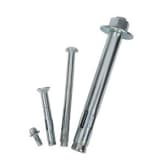
Male Expansion Brick Anchors (Sleeve Anchors)
The sleeve anchor is the most common male person expansion type anchor for brick walls. It provides the nigh consequent holding values. By pattern the sleeve anchor expands over a greater surface surface area than other types of expansion anchor. This gives the sleeve anchors the ability to aggrandize properly in the hollow or solid sections of brick. A sleeve ballast also works well in solid mortar joints. The mortar quality and quantity are most important to determine the sleeve anchor's ultimate holding value. At that place are many applications for sleeve anchors; one drawback is the lower shear strength than a similar female ballast. The sleeve ballast's designated size is equal to the outside diameter, and the stud is smaller. For example, a 3/8" sleeve ballast has a 5/xvi" stud. This gives the sleeve anchor a shear strength of a 5/16" anchor and not of a true iii/8" diameter fastener.
Available diameters – The sleeve anchor comes in six diameters and in several lengths for use in a diverseness of applications. To go the minimum sleeve anchor length, add together the item's textile thickness to the minimum embedment of the sleeve anchor.
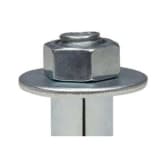
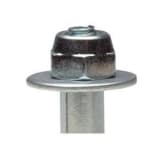
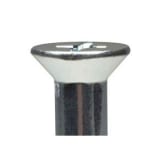
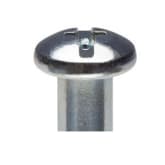
Available head styles – Sleeve anchors are bachelor with several head styles: acorn caput, hex caput, round head and flat head. The acorn caput is hex with a finished acorn head; the hex head is the standard hex nut; the round head is slotted for use with a direct screwdriver; the flat head is a countersunk Phillips or slotted bulldoze. Select the caput way based on the application where the sleeve anchor will be used.
Sleeve Anchor Lengths – The length of the sleeve anchor is measured from under the head for the acorn, hex caput and round sleeve anchors. The flat-head sleeve ballast is measured as an overall length.
Materials – Sleeve Anchors come in carbon steel and 304 stainless steel. Selecting the correct textile depends on the environment where the anchors are installed.
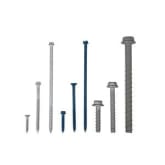
Self-Tapping Brick Masonry Anchors (Tapcon®/Concrete Screws)
Cocky-tapping brick anchors, concrete block or concrete screws are used for fastening items to brick. Concrete screws are most commonly called Tapcon® masonry screws. The heavy-duty masonry screw has the versatility for use in brick, mortar joints, CMU, block or solid concrete. Install the masonry screw in brick by selecting a carbide scrap with the correct bore for that screw. Drill a airplane pilot hole with a hammer drill with the carbide bit. Insert the masonry screw anchor into the pigsty in the brick and turned clockwise. This volition tap threads into the brick and hold the screw deeply.
Masonry Brick Screw Sizes – The standard masonry brick spiral comes in two diameters of 3/16", 1/4", 3/8" and 1/ii" with lengths ranging from 1-1/4" to 6-1/4". The minimum length of masonry brick screw is determined by adding the minimum embedment depth of i " to the thickness of the fabric being fastened.
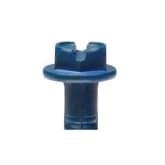
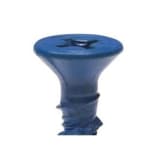
Head Styles – Ii caput styles are available with the standard masonry brick screw: the hex washer slotted, and the flat countersunk Phillips. All the hex washer slotted masonry brick screws lengths are measured from under the caput and the flat countersunk Phillips is measured as an overall length.
Materials – Depending on the environment, concrete screws come up in carbon steel, galvanized, 304 stainless steel, 316 stainless steel, or 410 stainless steel.
Female Brick Expansion Anchors
Several different types of female brick anchors are bachelor. The all-time one to use depends on preference and the specific application. Each female person anchor requires a bolt and washers to be purchased separately. Many times, the bolt chosen volition decide the female person anchor that will be used. If a lag screw is used, and then y'all would use the lag shield brick anchor. If a bolt is used with national coarse threads, then whatever of the female brick anchors with internal national coarse threads can exist used. Some female brick anchors crave a setting tool to be used to ready the brick anchor into the base textile. These types of brick anchors require that the anchor is placed then that setting tool can set the anchor into the brick properly.
Types of Female Brick Anchors
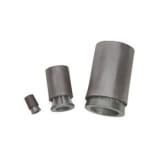
Motorcar Spiral Anchors – Often chosen AJ's or atomic number 82 anchors, they require a setting tool that has national coarse threads. They are bachelor in eight diameters and can be used in brick, cake or physical.
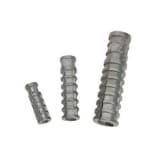
Lag Shield Anchors – These anchors are available in two different lengths of a short or long version and half dozen diameters. The lag shield is very versatile because it can be used in very dense base textile or in the base textile where the holding values are suspect. The lag shield does not require a setting tool and is expanded by inserting the correct lag screw into the anchor.
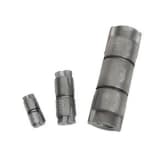
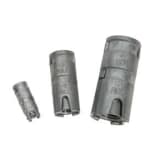
Double Expansion and Single Expansion Anchors – These anchors both come in 5 diameters, take national coarse internal threads and have good holding values in most base materials. The double expansion expands the entire length of the anchor trunk as opposed to the unmarried expansion that expands at one cease. The double expansion ballast is best for cases where the base of operations fabric may be soft, doubtable or inconsistent.
Brick anchors are fasteners that attach an item to brick or a mortar joint in a brick wall.
Mutual Brick Anchor Uses
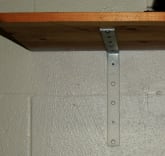
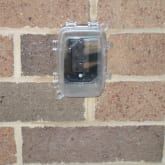

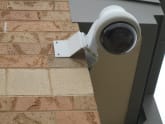
Among the many uses for brick anchors the most common are for installing shelving brackets, security cameras, electrical boxes, business firm street numbers and EXIT signs. The diverseness of anchors available volition make these installations adequately easy. Sleeve anchors may be the best choice, as they take many head styles available for ease of installation and the expect of the last installation.
Required Safety Equipment
When drilling a hole to install a brick anchor, make certain to have tools on mitt to remove rest dust from the hole. This could be compressed air, a wire brush or a shop vacuum.
At present that you have the appropriate hammer drive drill and masonry drill fleck, you should think about safety equipment. Safety goggles are a must to protect eyes from grit and concrete chips. Because of the dust, yous may also want to consider wearing a dust mask. All drilling jobs tend to exist noisy, but hammer drilling is considerably louder than standard drilling. Therefore, ear protection is important (especially for larger jobs).
Purchase Anchors
Source: https://www.concretefasteners.com/diy-articles-brick-anchors/
0 Response to "What Information Is Most Important When Determining What Fastener to Use?"
Postar um comentário